

Last Updated: October 26, 2026
Quick Summary
Model train starter sets combine a locomotive, rolling stock, track, controller, and power supply in one package, with HO scale offering the best balance of detail and space for most beginners. Choose based on your available space and budget: HO scale fits a 4-by-8-foot table, N scale fits a 2-by-4-foot shelf, and O gauge requires 6-by-12 feet but offers easier handling.
- HO scale is the industry standard for beginners, offering strong compatibility across brands and enormous selection of locomotives and rolling stock.
- N scale trains are half the size of HO, fitting on a 2-by-4-foot shelf or table, making them ideal for apartment dwellers with limited space.
- A quality mid-range starter set outperforms a budget set dramatically and represents the best value for learning the hobby without frustration.
- Expansion typically follows a natural progression: more track, additional locomotives, scenery, and eventually digital command control upgrades.
- Regular operation and track maintenance are essential; clean track weekly and run trains regularly to keep motors exercised and spot problems early.
Table of Contents
- What Makes a Great Model Train Starter Set
- Model Train Scales Explained for Beginners
- Top Model Train Starter Sets Ranked by Budget and Space
- Model Train Sets with Track and Locomotive Included
- How to Expand and Upgrade Your Starter Set
- Common Beginner Mistakes and How to Avoid Them
- Getting Started: Your First Layout and Setup
- Frequently Asked Questions
What Makes a Great Model Train Starter Set
A great model train starter set combines three things: everything you need to run trains immediately, quality components that won’t frustrate you in week two, and room to grow without replacing what you already own. Most beginners make the mistake of chasing the cheapest option or the most features. Both paths lead to the same place: disappointment.
The best starter sets balance affordability with reliability. They include a locomotive that runs smoothly, track that doesn’t derail every five minutes, and a power supply that’s actually safe.
Your first set should feel like an invitation, not a commitment. You’re learning how the hobby works: how to operate trains, build a layout, troubleshoot problems. A quality starter set teaches you these skills without the frustration of cheap components failing mid-session.
Model Train Scales Explained for Beginners
Scale determines how big your trains are and how much space you need. Most beginners choose between three main options, and the choice matters far more than which specific locomotive you pick.
Scale is the ratio between your model and a real train. HO scale is 1:87, meaning a real locomotive 87 times larger would match your model’s proportions (Scales & More). N scale is 1:160, so models are smaller (Scales & More). O gauge is 1:48, so models are larger (Scales & More). The smaller the denominator, the bigger your trains.
Here’s the practical difference: HO scale trains fit on a 4-by-8-foot table. N scale fits on a 2-by-4-foot shelf. O gauge needs serious space but is easier to work with if your hands aren’t steady. Most beginners start with HO because the scale offers the best balance between detail, cost, and space requirements.
HO Scale Train Sets for Beginners
HO scale is the industry standard for good reason. It’s large enough to see detail clearly, small enough to fit in a bedroom or basement, and the selection of locomotives and rolling stock is enormous. Compatibility is strong across brands, so you can mix and match as you expand.
HO scale trains run on two rails with electricity flowing through the rails to power the locomotive. A transformer converts wall current to safe, low-voltage power. Most beginner sets use analog control, meaning you adjust a dial to control speed.
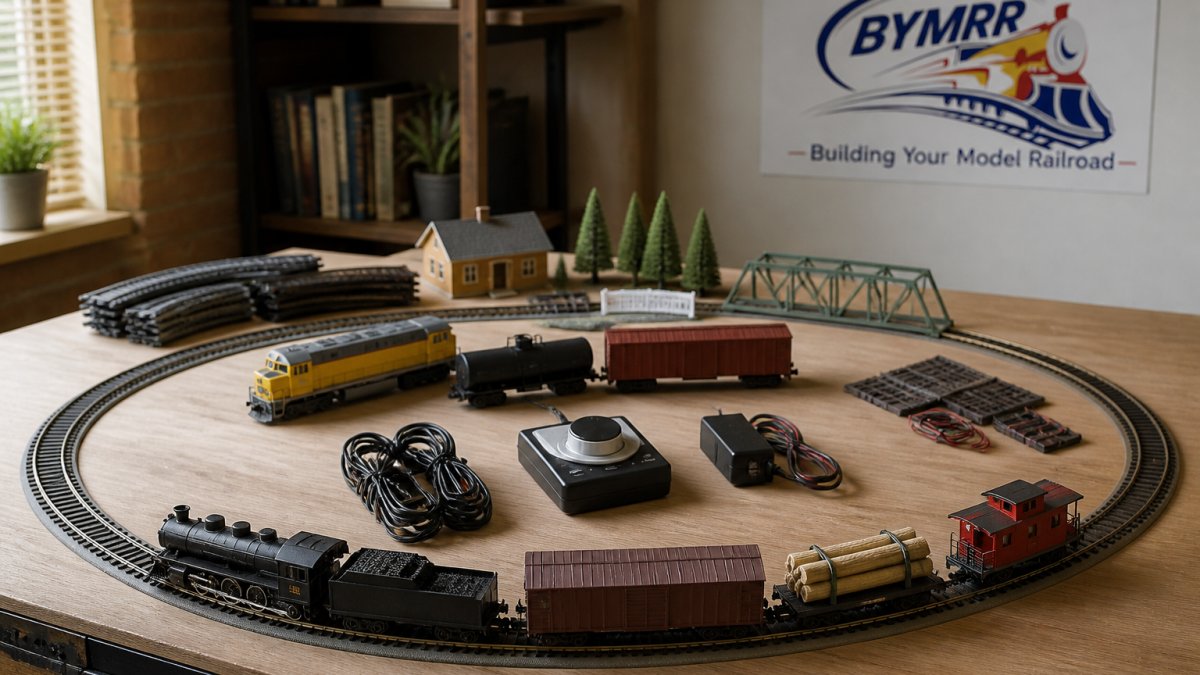
An HO scale starter set typically includes a locomotive, three to five cars, an oval of track, a controller, and a power supply. Expect the layout to fit on a 4-by-8-foot table. This is the sweet spot for most hobbyists because you get real trains that perform well without overwhelming complexity.
N Scale Train Sets for Beginners
N scale is half the size of HO, which means your entire layout fits in half the space. A complete N scale layout runs on a 2-by-4-foot table or even a shelf. The trade-off is detail and ease of handling. Smaller components are harder to work with if you have limited dexterity, and scenery details are trickier to add.
N scale is popular with hobbyists who live in apartments or have limited space. The locomotives are reliable and run well straight out of the box. Rolling stock selection is good, though not as vast as HO. Compatibility between brands is generally strong, so expansion works smoothly.
Start with N scale if space is your limiting factor. The trains perform well, and the hobby is just as rewarding at a smaller scale. You’re not sacrificing quality; you’re adapting to reality.
O Gauge and G Scale Options
O gauge is significantly larger than HO. Locomotives are substantial, easier to handle, and the detail is impressive. The trade-off is space. An O gauge layout needs a 6-by-12-foot table minimum to feel worthwhile. O gauge is popular with collectors and hobbyists who prioritize detail over layout size.
G scale is the largest common scale and is often used for outdoor layouts. Trains are strong and weather-resistant. G scale is less common for beginners indoors but worth considering if you want to run trains outside.
Most beginners should start with HO or N scale. O gauge makes sense if you have the space and want maximum detail. G scale is specialized and better suited to experienced hobbyists with outdoor plans.
The three main scales for beginners differ significantly in size, space requirements, and ease of use.
| Scale | Ratio | Minimum Table Size | Best For |
|---|---|---|---|
| HO | 1:87 | 4 by 8 feet | Balance of detail, cost, and space |
| N | 1:160 | 2 by 4 feet | Limited space or apartments |
| O gauge | 1:48 | 6 by 12 feet | Maximum detail and easier handling |
Top Model Train Starter Sets Ranked by Budget and Space
The best starter set depends on your budget, available space, and whether you want to focus on operations or scenery. We’ve ranked options across these categories so you can find the right fit.
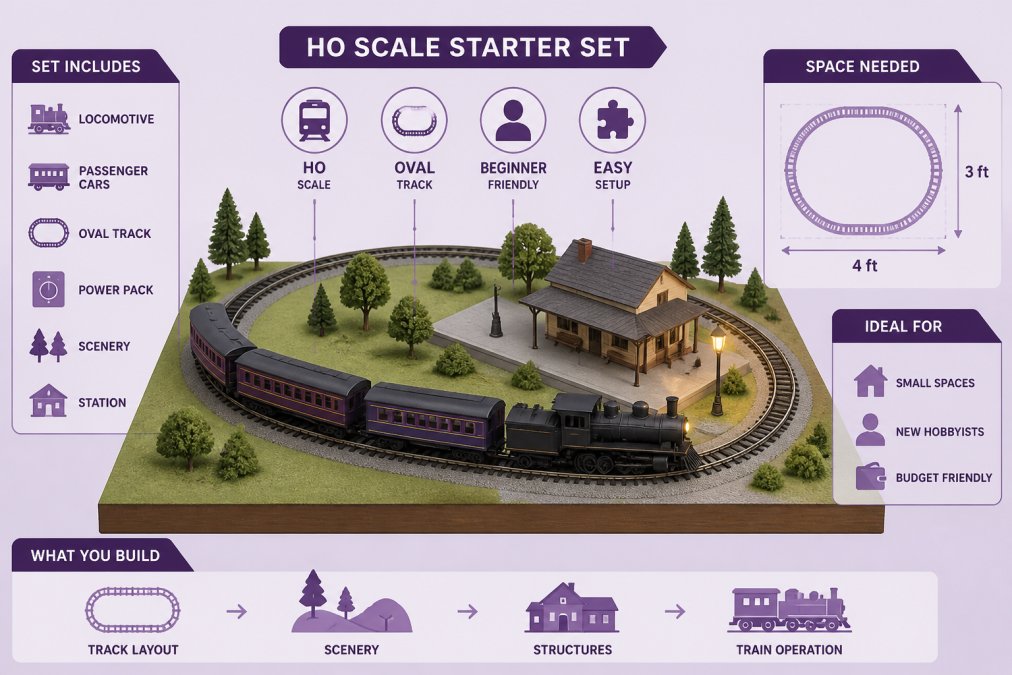
Budget-Friendly HO Starter Sets: These sets run between modest price points and include a basic locomotive, four to six cars, oval track, a simple controller, and a power supply. The locomotive is typically an older design or a generic freight engine, which keeps costs down. Quality is solid enough for learning, though the locomotive may not have sound or lighting features. These sets work well if you want to test the hobby before investing heavily.
Mid-Range HO Sets: These include better-quality locomotives with more detail, more cars, and a larger track footprint. Many include a small amount of scenery material and track switches so you can add sidings. The power supply is more strong, and the controller offers better speed control.
Premium HO Sets: These feature detailed locomotives with sound and lighting, extensive rolling stock, multiple switches, and a larger track configuration. Scenery materials and accessories are often included.
N Scale Starter Sets: Budget N scale sets fit on a shelf and include a small locomotive, three to four cars, and an oval of track. Mid-range N sets add more cars, better detail, and track switches. Premium N sets rival HO sets in detail but occupy a quarter of the space. Choose N scale if your space is severely limited or if you want to build a complex layout in a small footprint.
O Gauge and G Scale: These are less common for absolute beginners because they require significant space and represent a larger investment. If you have the room and budget, they offer impressive detail and easier handling.
Model Train Sets with Track and Locomotive Included
The best starter sets include everything needed to run trains immediately. You should not need to buy track, a controller, or a power supply separately.
Look for sets that specify what’s included. A complete starter set lists the locomotive model, the number and type of cars, the track configuration (typically an oval), the controller type, and the power supply wattage.
The locomotive is the heart of your set. It should have reliable motor, smooth operation, and good pulling power. Most modern starter locomotives run well out of the box.
Rolling stock (the cars) should run smoothly on the track. Wheels should spin freely, and couplers should connect and release reliably. A good starter set includes a mix of car types: passenger cars, freight cars, and a caboose.
How to Expand and Upgrade Your Starter Set
Your starter set is a foundation, not a ceiling. The best part of model railroading is building from that foundation into something uniquely yours.
Start by adding more track. An oval is fun, but a figure-eight or a more complex layout keeps interest alive. You can find detailed guidance on layout planning in our step-by-step layout guide.
Next, add a second locomotive or more rolling stock. Your starter set probably includes one locomotive.
Scenery comes next. Mountains, trees, buildings, and roads transform a simple oval into a miniature world. Scenery is where the hobby becomes art.
Digital command control (DCC) is an advanced upgrade that lets you run multiple trains independently on the same track.
Explore our comprehensive guide to model train accessories to understand what’s available and how each piece fits into your layout.
Common Beginner Mistakes and How to Avoid Them
The most common mistake is buying a cheap set to save money, then feeling frustrated when the locomotive stalls, the track causes derailments, or the controller is unreliable.
Another mistake is buying too much track before learning how to operate what you have.
Many beginners neglect track maintenance. Clean track regularly with a track cleaning car or a soft cloth. Dirty track causes derailments and stalls. This is not optional; it’s the single most important maintenance task.
Overloading your first locomotive is tempting. A small locomotive can pull four or five cars comfortably but struggles with eight. Know your locomotive’s pulling power and respect it.
Finally, avoid mixing scales or gauges. HO and N are not compatible. Mixing scales creates frustration and wastes money. Learn more about how to start model railroading properly to avoid these pitfalls from the beginning.
Getting Started: Your First Layout and Setup
Your first layout doesn’t need to be complicated. An oval of track on a 4-by-8-foot table is a legitimate, enjoyable layout.
As you gain confidence, add a second loop, a siding, or a crossover. Each addition teaches you something new about how trains operate.
Setup is straightforward. Assemble your track according to the instructions in your starter set. Connect the controller to the power supply.
Identify the essential tools you’ll need to build and maintain your layout.
Run your trains regularly. This is not just fun; it’s maintenance. Running trains keeps the motor in your locomotive exercised and helps you spot problems early.
Starting model railroading doesn’t require years of experience or a massive budget. A quality starter set, a few hours to build your first layout, and regular operation are all you need.
Frequently Asked Questions
What should a model train starter set include?
A complete model train starter set should include a locomotive, at least three to five cars (rolling stock), an oval or basic track layout, a power supply or controller, and often basic scenery or accessories. Many sets include instruction guides for assembly and operation. The track should form a complete circuit so the locomotive can run continuously. Look for sets that bundle everything you need to start running trains immediately without additional purchases.
Are HO or N scale trains better for beginners?
HO scale is generally better for most beginners because locomotives and cars are larger, easier to handle, and simpler to troubleshoot. HO scale also offers more detailed scenery and accessories. N scale is ideal if you have limited space, as it allows more track and scenery in a smaller footprint. Choose HO if you prioritize ease of use and detail; choose N if space is your main constraint.
Can you expand a model train starter set later?
Yes, most starter sets are designed for expansion. You can add more track, additional locomotives and rolling stock, digital command control (DCC) systems, scenery, and lighting. However, verify compatibility before purchasing add-ons, check the gauge, scale, and whether the set uses analog or digital control. Many hobbyists start with a basic oval and gradually build complex layouts with multiple train lines and detailed scenery over time.
How much does a good model train starter set cost?
Pricing depends on scale, gauge, included features, and brand. Entry-level sets typically offer good value for beginners, while premium options include more detailed locomotives, better track quality, and advanced features like sound and lighting. Visit BYMRR’s website for current pricing and special offers on starter sets in your preferred scale. Our team can also help you find a set that fits your budget and space requirements.
