

Last Updated: October 23, 2026
Quick Summary
Model train accessories are available online in enormous selection across multiple scales, with HO scale being the most popular in North America. Before buying model train accessories online, you must choose your scale based on available space, verify coupler compatibility, and purchase from reputable retailers to ensure parts work together reliably.
- HO scale (1:87) is the most popular standard in North America with the largest selection of model train accessories
- Scale compatibility is critical; HO accessories don’t fit N scale, and mixing coupler types causes operational problems
- Starter sets bundle locomotives, cars, track, and power supplies designed to work together, eliminating compatibility guessing
- Premium track and locomotives cost only 20-30% more than budget options but offer dramatically better reliability and performance
- Reputable online retailers use protective packaging and insurance for shipping model train accessories, with clear return policies for damage claims
Table of Contents
- Understanding Model Train Accessories and Your Needs
- Model Train Accessories by Scale: Finding the Right Fit
- Model Train Accessories for Beginners: Where to Start
- Model Train Layout Supplies: Building Your Railroad
- Vintage Model Train Parts: Sourcing Rare and Hard-to-Find Pieces
- How to Choose Compatible Model Train Accessories
- Shopping for Model Train Accessories Online: What to Expect
- Frequently Asked Questions
Understanding Model Train Accessories and Your Needs
Buying model train accessories online opens up possibilities that local hobby shops simply can’t match. The sheer selection, competitive pricing, and convenience of having parts delivered to your door make online shopping the default choice for most hobbyists today.
At BYMRR, we’ve spent since 2008 helping hobbyists navigate this landscape. The foundation is understanding what you actually need before you start clicking “add to cart.”
Model train accessories fall into several distinct categories. Locomotives and rolling stock form the core of any collection. Track systems, switches, and electrical components create the infrastructure. Scenery, buildings, and figures bring your miniature world to life.
The good news? Once you understand these basics, shopping for model train accessories online becomes straightforward and rewarding.
Model Train Accessories by Scale: Finding the Right Fit
Scale is the first decision that determines everything else. Your choice locks you into a specific ecosystem of compatible locomotives, cars, track, and structures. Getting this wrong means starting over from scratch.
HO Scale Accessories
HO scale (1:87) is the most popular standard in North America. More hobbyists choose HO than any other scale, which means the selection of model train accessories is enormous.
The advantage of HO scale is variety and affordability. Competition among manufacturers keeps pricing competitive. The disadvantage is space, HO layouts demand real estate. A modest HO layout typically requires a table at least 4 feet by 8 feet.
When shopping for HO scale model train accessories online, focus on coupler compatibility first. Most modern HO equipment uses Kadee couplers or compatible standards. Older HO equipment sometimes uses different coupling systems, which can cause problems if you’re mixing vintage and modern cars.
N Scale and O Scale Options
N scale (1:160) appeals to hobbyists with limited space. A detailed N scale layout fits on a coffee table. The trade-off is precision, N scale requires steadier hands and better eyesight than HO. Model train accessories for N scale are available but less abundant than HO options.
O scale (1:48) is the opposite extreme (Scales & More). O scale locomotives are substantial, detailed pieces. They’re often collectible rather than operational. Many O scale hobbyists display their locomotives rather than run them on layouts.
G scale (1:22.5) is designed for outdoor layouts. G scale trains are large, durable, and weather-resistant. Garden railways have grown in popularity, and G scale model train accessories reflect that trend.
G Scale for Larger Layouts
G scale offers something unique: the ability to run trains outdoors on permanent or semi-permanent layouts. G scale locomotives and rolling stock are built to withstand weather, and the track systems are engineered for outdoor use.
The appeal is obvious if you have yard space. A G scale layout can become a genuine garden feature. The drawback is maintenance. Outdoor track requires regular cleaning, and metal components need protection from rust. If you’re serious about G scale, budget for track cleaning tools and protective coatings alongside your model train accessories.
Beginners often underestimate the complexity of outdoor layouts. Start simple, a basic oval of track with a few cars and one locomotive. As you gain experience, add sidings, switches, and scenery. This staged approach prevents costly mistakes.
Model Train Accessories for Beginners: Where to Start
Starting in model railroading doesn’t require years of planning or a massive budget. What it requires is a clear sequence of decisions.
First, choose your scale based on available space. Measure your layout area honestly. Second, buy a starter set from a reputable retailer.
Third, run your first layout and learn how it operates. Run trains, troubleshoot problems, and understand your power system.
Many beginners rush to buy detailed scenery, custom buildings, and rare locomotives before they understand how to keep a train running reliably. This backward approach leads to expensive collections that rarely see operation.
BYMRR’s comprehensive model railroading guides walk you through this process step by step. We help you choose the right scale, select your first starter set, and plan your layout expansion.
Model Train Layout Supplies: Building Your Railroad
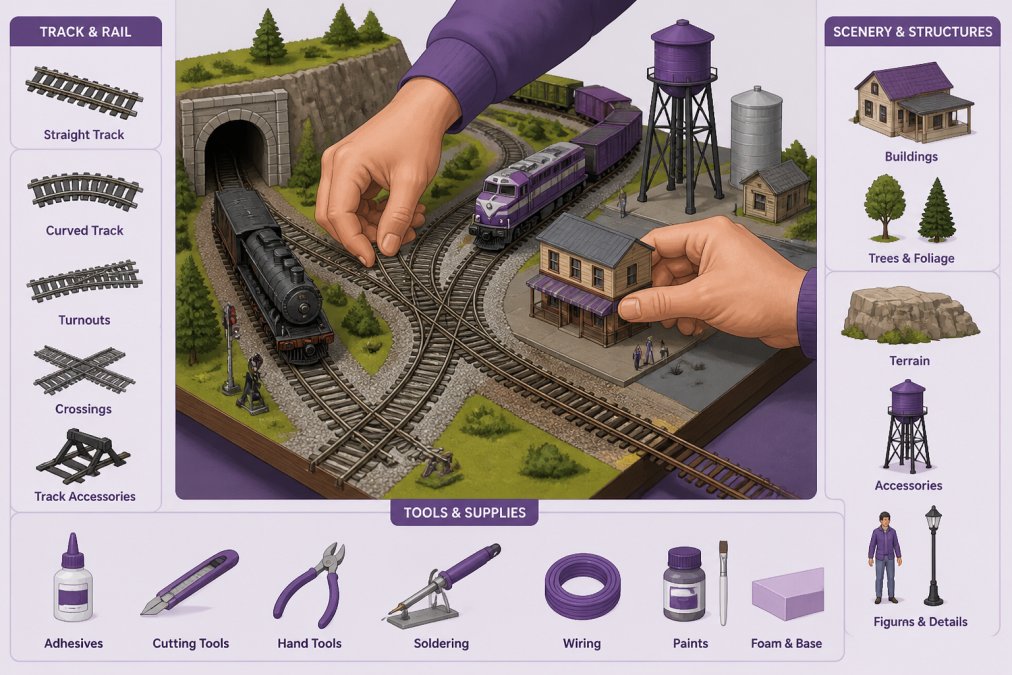
Once your basic track and locomotive are working, layout supplies transform your setup from functional to impressive. This is where model railroading becomes genuinely fun.
Track, Switches, and Electrical Components
Track quality determines reliability. Budget track works, but premium track systems hold tolerances more tightly, reducing derailments. Switches (also called turnouts) direct trains onto different routes. Electrical components, power supplies, transformers, and control systems, deliver power to your track and let you control speed and direction.
When buying model train accessories for track systems, verify compatibility with your scale and existing track. Mixing track brands sometimes works, but it introduces variables. Sticking with one manufacturer’s system simplifies troubleshooting.
Electrical components are where many beginners struggle. A basic power supply works for simple layouts, but as you add more track and switches, you may need additional power districts. This prevents voltage drops that cause stalling. Understanding your electrical system prevents frustration down the road.
Scenery and Structural Elements
Scenery transforms a layout from a toy train set into a miniature world. Trees, grass, rocks, water features, and terrain sculpting create context. Buildings, signs, and figures populate your scene.
Quality scenery accessories make a dramatic difference in appearance. Cheap plastic trees look cheap. Detailed resin buildings with interior lighting look professional. The investment in good scenery pays dividends in visual impact.
Start with terrain. Build your landscape foundation using foam, plaster, or commercial terrain materials. Add track and basic structures. Then layer in details, trees, shrubs, figures, and vehicles. This sequence prevents having to rebuild scenery around track later.
Vintage Model Train Parts: Sourcing Rare and Hard-to-Find Pieces
Collecting vintage model train accessories appeals to many hobbyists. Vintage Lionel trains, prewar Märklin locomotives, and classic American Flyer equipment represent history and craftsmanship.
Sourcing rare pieces requires patience and knowledge. Online auctions, specialty dealers, and collector networks are your best sources. Condition matters enormously. A pristine vintage locomotive commands premium prices. One with missing parts or rust might cost a fraction as much.
Restoration is a specialized skill. Some hobbyists enjoy bringing vintage equipment back to life. Others prefer to keep pieces in original condition. Either approach is valid, choose based on your interests and skill level.
When buying vintage model train accessories, verify authenticity. Reproductions exist, and some sellers misrepresent them. Buy from established dealers with strong reputations.
How to Choose Compatible Model Train Accessories
Compatibility breaks down into two main categories: mechanical and electrical.
Checking Scale and Coupler Compatibility
Scale compatibility is straightforward, HO accessories don’t fit N scale, and vice versa. Within a scale, coupler compatibility matters. Couplers are the mechanisms that connect cars to locomotives and to each other.
Most modern HO equipment uses Kadee couplers or compatible standards. Older equipment uses different systems. If you’re mixing eras, you may need to replace couplers on vintage cars. This is a common upgrade that costs little but requires patience.
Verify coupler type before purchasing model train accessories. Seller descriptions usually specify the coupler standard. If they don’t, ask. A five-minute clarification prevents costly incompatibility.
Quality and Durability Considerations
Not all model train accessories are created equal. Budget options work, but premium options offer better detail, smoother operation, and longer lifespan.
Locomotives are where quality matters most. A budget locomotive might derail frequently or stall on slight grades. A quality locomotive runs reliably for years. The difference in price is often modest, sometimes just 20-30% more for dramatically better performance.
Rolling stock (cars) varies less dramatically. Budget cars work fine. Premium cars feature better detail, metal wheels instead of plastic, and more realistic couplers. For display layouts, premium cars are worth the investment. For operational layouts where cars get heavy use, the difference is less critical.
Track quality affects reliability. Premium track holds tighter tolerances, reducing derailments. Budget track works but requires more maintenance and adjustment.
Shopping for Model Train Accessories Online: What to Expect
Online shopping for model train accessories requires understanding return policies, shipping practices, and damage protection.
Shipping, Returns, and Damage Protection
Locomotives and delicate model train accessories require careful packaging. Reputable online retailers use protective materials and insurance. Damage during shipping does happen, but legitimate sellers handle claims professionally.
Before purchasing, review the retailer’s return policy. Can you return damaged items? What’s the timeframe? Are return shipping costs covered? These details matter.
Shipping costs vary based on weight and distance. Heavy locomotives might cost $15-30 to ship. Smaller accessories might ship for $5-10. Factor shipping into your total cost when comparing prices.
Insurance protects against loss or damage. Some retailers include it automatically. Others offer it as an option. For expensive model train accessories, insurance is worth the small additional cost.
Member Discounts and Special Offers
If you’re an NMRA member, ask retailers about member discounts. BYMRR honors NMRA membership with competitive member pricing on select model train accessories.
Email newsletters often feature exclusive deals. Signing up for a retailer’s newsletter puts you first in line for sales and clearance items. Seasonal sales, especially around holidays, offer significant discounts.
Buying model train accessories online combines convenience with responsibility. You have access to the world’s inventory, but you need to make informed choices about scale, compatibility, and quality. Start with a clear plan, buy from reputable retailers like BYMRR, and expand gradually as you gain experience. Since 2008, we have provided hobbyists with a comprehensive selection of locomotives, kits, accessories, and tools to create stunning, detailed layouts.
| Accessory Category | Best For | Compatibility Consideration |
|---|---|---|
| Locomotives | Operational layouts, display collections | Scale and electrical system matching |
| Rolling stock | Completing consists, adding variety | Coupler type and scale |
| Track systems | Layout foundation | Brand consistency recommended |
| Switches/turnouts | Route control, operational complexity | Scale and power district planning |
| Scenery elements | Visual impact, realism | Personal preference, no compatibility issues |
| Electrical components | Power delivery, speed control | Amperage capacity for layout size |
Frequently Asked Questions
How do I choose model train accessories that fit my scale?
Scale compatibility is essential for a functioning layout. Check your locomotives and rolling stock for scale markings (HO, N, O, or G are most common). All accessories for your layout must match that scale, track, couplers, buildings, and figures should be labeled accordingly. Mix scales and your trains will derail or look disproportionate. When ordering, verify the product description lists your scale explicitly.
What are the most useful model train accessories for beginners?
Start with track extensions, a power supply rated for your scale, and replacement couplers. Add scenery basics like ballast and ground cover, then buildings and figures to bring your layout to life. Beginners often overlook track cleaning supplies and maintenance tools, these prevent derailments and electrical problems. BYMRR’s comprehensive model railroading guides help you prioritize purchases based on your layout size and budget.
Where can I find vintage or hard-to-find model train parts?
Vintage pieces require patience and targeted searching. Online retailers specializing in hobby supplies often stock discontinued items from major manufacturers. Check product listings carefully, vintage parts may have wear or require cleaning.
How do I know if model train accessories will arrive in good condition?
Reputable online retailers pack fragile items like locomotives and rolling stock with protective materials and insurance options. BYMRR ships with free shipping and a money guarantee, if your order arrives damaged, contact support immediately with photos. Always inspect packages upon delivery and report damage within the return window. Keeping original packaging helps with claims. Ask retailers about their damage policy before ordering high-value items.
