

Table of Contents
- What to Look for in Model Train Kits for Beginners
- Choosing a Model Scale: HO Scale Model Train Sets and Beyond
- Top Model Train Starter Sets Worth Your Investment
- How to Power Model Trains: Transformers, Controllers, and Track
- Model Train Layout Ideas for Beginners: Space and Expansion
- Total Cost of Starting the Hobby and What’s Included
- Getting Started: Setup, Assembly, and First Run
- Frequently Asked Questions
Last Updated: October 12, 2026
What to Look for in Model Train Kits for Beginners
The best model train kits for beginners match your skill level, include everything needed to run trains on day one, and leave room to grow without replacing core components.
Skill Level and Assembly Requirements
Not all kits demand the same patience or technical knowledge. Some arrive ready to run straight from the box; others require assembling locomotives, wiring power systems, and troubleshooting connections before your first train moves.
For true beginners, ready-to-run kits eliminate early frustration: unbox, snap together track, connect power, and run trains within 30 minutes. If you enjoy hands-on work, a semi-assembled kit is a middle ground, with a partially built locomotive you finish while learning how trains function.
Be honest about your patience: someone wanting immediate gratification will abandon a four-hour assembly, while a model builder finds ready-to-run boring.
Ready-to-Run vs. DIY Assembly Kits
Ready-to-run kits come with assembled locomotives, pre-formed track, and tested controllers, so you’re operating within an hour. They cost more per component but suit hobbyists focused on layout design and operation rather than soldering.
DIY assembly kits require building the locomotive from parts, soldering connections, and wiring track. They cost less upfront but demand more time and skill; you’ll learn how trains work, but the learning curve is steeper.
For beginners, start ready-to-run unless you have model-building experience; add assembly projects later. Many experienced hobbyists run both types.
Choosing a Model Scale: HO Scale Model Train Sets and Beyond
Model scale is the ratio between your miniature train and a real locomotive, determining layout size, cost, and detail. Scale is non-negotiable: you can’t mix HO trains with N scale track or O gauge locomotives.
Why HO Scale Dominates for Beginners
HO scale (1:87) is the industry standard: a typical locomotive is about 10 inches long, and a complete oval fits on a 4-by-8-foot table, large enough for fine detail and multiple trains without a dedicated room.
HO scale model train sets also have the deepest ecosystem: every major manufacturer produces HO locomotives and rolling stock, from a 1950s Santa Fe diesel to a modern Union Pacific freight engine, so parts and upgrades remain available for decades.
Detail is exceptional, with working couplers, detailed truck assemblies, and painted windows, so your layout looks impressive without obsessive scenery work.
N Scale and O Gauge Alternatives
N scale (1:160) is half the size of HO: a locomotive is about 5 inches long, and a complex layout fits on a 2-by-4-foot table. It suits limited space or large networks, but detail is harder to see and prices per locomotive are comparable to HO.
O gauge (1:48) is substantially larger, with locomotives 20 inches or more. It demands significant space and money but is popular with collectors and vintage railroad modelers, offering stunning detail and substantial operation.
For beginners, HO scale model train sets remain the best choice. You get the right balance of size, detail, cost, and available products.
Top Model Train Starter Sets Worth Your Investment
The best model train kits for beginners combine a quality locomotive, realistic rolling stock, reliable track, and a functional power supply. Here’s how we evaluate them:
Budget-Friendly Starter Kits
Budget-friendly options typically include a single locomotive, 4-6 cars, an oval of track, and a basic controller. They run reliably but often have simplified locomotives, plastic wheels, and track needing frequent cleaning.
A budget starter set suits anyone unsure the hobby will stick: you spend less than a quality bicycle and still get a complete, functional model railroad, then upgrade components as preferences emerge.
Look for sets that include metal wheels on the locomotive and cars, they roll more smoothly and reduce derailments. Plastic wheels look cheaper and perform worse.
Mid-Range Quality Options
Mid-range starter sets jump in quality: finer locomotive detail, metal wheels, better motors, brass or nickel-silver track with better conductivity, and controllers with variable speed, direction control, and sometimes basic automation.
Most hobbyists land here, paying for noticeably better performance and detail without premium pricing; a mid-range set satisfies for years as you expand.
Premium Kits for Serious Hobbyists
Premium starter sets include high-end locomotives with detailed paint, accurate proportions, and superior motors, plus excellent track and advanced controllers, positioning you to build a serious layout without replacing core components.
Premium kits make sense only if you’ve researched extensively and know you’re committed; newcomers learn what features matter by starting smaller.
How to Power Model Trains: Transformers, Controllers, and Track
This is where many beginners get confused. The power system is not complicated, but understanding it prevents costly mistakes.
Understanding Power Supply Basics
Model trains run on low-voltage DC or AC depending on the system; most modern HO sets use DC. Your transformer converts household current to safe low voltage, which flows through the track to the locomotive’s motor.
The controller regulates voltage to control speed; reversing polarity reverses direction. That’s the entire system.
Quality matters: a cheap transformer can overheat or fail and damage your locomotive. Mid-range and premium sets include reliable transformers rated for their locomotives’ draw; budget transformers are adequate but not strong.
Transformer and Controller Selection
Your transformer must supply enough amperage for your locomotive and future cars. A typical HO locomotive draws 1-2 amps; running multiple trains simultaneously requires higher amperage or multiple transformers.
Controllers range from simple rheostat dials to digital systems that program train movements. For beginners, a basic controller is fine; you’ll learn whether you want advanced features before investing.
One critical detail: ensure your transformer and controller are compatible with your track system, since some are proprietary and mixing manufacturers causes issues.
Track Quality and Wiring
Track is brass or nickel-silver. Nickel-silver is superior, resisting oxidation and needing less cleaning; brass oxidizes quickly and demands regular maintenance for reliable electrical contact.
Wiring carries power from the transformer; undersized wire creates voltage drops that slow trains. Use the manufacturer’s recommended gauge, since poor wiring causes frustrating intermittent problems that are hard to diagnose.
Many beginners overlook track and wiring, then spend weeks troubleshooting derailments and stalls actually caused by poor electrical connections. Quality track and proper wiring prevent 80% of common beginner problems.
Model Train Layout Ideas for Beginners: Space and Expansion
Your layout is where the hobby becomes real. A well-planned layout keeps trains running smoothly and gives you room to expand.
Space Requirements and Footprint Planning
An oval track layout, the classic beginner setup, requires a 4-by-8-foot table for HO scale, the minimum for satisfying operation. Smaller layouts force trains through tight curves, which looks unrealistic and increases derailment risk.
Plan your layout before buying track: sketch it, measure your space, and ensure your table fits. An undersized layout is frustrating and quickly outgrown.
Consider vertical space too. A layout 3-4 feet high is comfortable to operate. Higher layouts require a step stool and become tiring to use. Lower layouts are hard on your back.
Oval Track Basics and Layout Expansion
Start with a simple oval. It’s forgiving to build, operates reliably, and teaches you the basics. Once you understand how trains behave, you can add sidings, crossovers, and branch lines.
Sidings let you park cars while running the main line, essential for realistic operation. Crossovers let trains switch between parallel tracks. These additions are simple to add later; you don’t need them immediately.
Plan expansion routes before building. Leave space for a second loop or a branch line. This prevents the frustrating situation where you’ve built yourself into a corner and can’t expand without tearing down what you’ve already created.
Total Cost of Starting the Hobby and What’s Included
Understanding the complete cost picture prevents sticker shock and helps you budget properly.
Starter Set Contents Breakdown
A complete model train starter set includes:
- One locomotive
- Four to six cars (mix of freight and passenger)
- Track (typically 40-60 pieces forming an oval)
- Power transformer
- Controller
- Basic instruction manual
- Couplers and spare parts
This is genuinely everything needed to run trains. You don’t need to buy anything else to get started.
Hidden Costs and Compatibility Upgrades
Beyond the starter set, most hobbyists add:
- A layout table (you can build one or use an existing table)
- Additional track for expansion
- Scenery materials (trees, buildings, landscape)
- Additional locomotives and cars
- Cleaning supplies for track maintenance
- Lighting for your layout
These aren’t required immediately. You can run your starter set on any flat surface for months before building a proper layout. Add components gradually as your interest deepens and your budget allows.
Compatibility is crucial. Ensure any additional locomotives, cars, and track you buy are the same scale and system as your starter set. Mixing scales or incompatible systems wastes money.
Getting Started: Setup, Assembly, and First Run
The first time you see your trains move is genuinely exciting. Here’s how to get there.
Unboxing and Initial Assembly Steps
- Remove all components and check against the included parts list. Look for damage, dented boxes, cracked plastic, or bent metal.
- Assemble the track according to the instruction manual. Snap sections together firmly; loose connections cause electrical problems.
- Connect the power transformer to household current and to the track according to the manual. Double-check polarity, reversing positive and negative won’t damage anything, but your trains will run backward.
- Place the locomotive on the track and ensure it sits level. Wheels should contact the track firmly.
- Adjust the controller to the center position and turn on the transformer.
- Slowly increase controller voltage. The locomotive should begin moving smoothly.
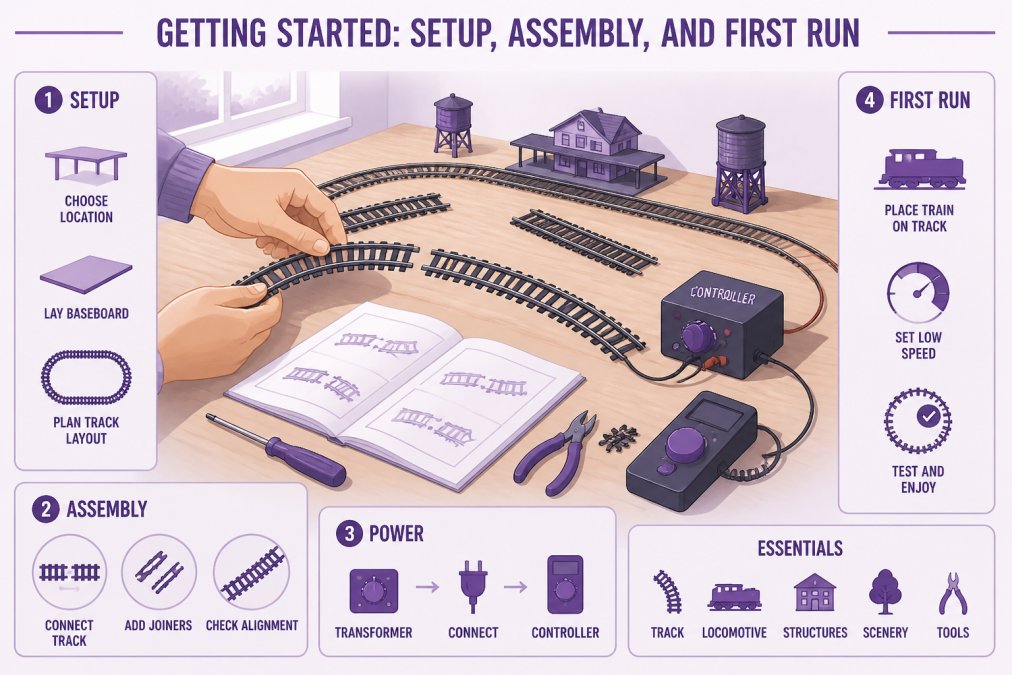
If the locomotive doesn’t move, check that all track sections are firmly connected and that the power transformer is on. Clean the wheels and track with a soft cloth, dust and oxidation prevent electrical contact.
Common Beginner Mistakes to Avoid
Derailments on curves: Running trains too fast causes derailments on tight curves. HO scale trains should navigate standard curves smoothly at moderate speed.
Stalled trains: A stalled locomotive usually means poor electrical contact.
Incompatible components: Mixing HO scale and N scale, or using cars with incompatible couplers, causes operational headaches.
Overpowering the transformer: Running multiple locomotives simultaneously on a budget transformer can cause overheating. Check your transformer’s amperage rating and stay within limits.
Ignoring track quality: Cheap track causes more problems than cheap locomotives. Invest in quality track and proper wiring from the start.
Starting with the best model train kits for beginners is about matching your expectations to a realistic entry point. At BYMRR, we’ve guided hobbyists through this decision. Once you understand how the hobby works, you can expand with confidence. The National Model Railroad Association provides detailed guidance on scales and standards.
Frequently Asked Questions
What should a beginner look for in a model train kit?
Beginners should prioritize ready-to-run kits that include a complete locomotive, rolling stock, track, and power supply. Look for clear assembly instructions, quality locomotives that run smoothly, and track that connects easily. HO scale offers the best balance of detail, affordability, and availability. Avoid kits requiring extensive soldering or wiring knowledge unless you’re comfortable with those skills.
How much space do you need for a beginner model train layout?
A basic oval track layout for beginners requires a minimum of 4 feet by 8 feet, though smaller 2-by-3-foot configurations work for very tight spaces. Larger layouts (6 by 12 feet or more) allow for more detailed scenery and realistic operation. Consider your available space before purchasing, many starter sets are designed for standard sheet plywood bases that fit standard table dimensions.
Can you expand a model train starter set later?
Yes, most quality starter sets are designed for expansion. You can add additional track sections, locomotives, passenger cars, freight cars, and accessories over time. However, check compatibility before buying, ensure new components match your scale and power system. Some budget kits use proprietary connectors that limit expansion options.
Are HO scale model trains good for beginners?
HO scale is the most beginner-friendly choice. It offers excellent detail and realism, abundant affordable track and locomotive options, and moderate space requirements. HO scale kits are widely available, well-documented in hobby communities, and easier to troubleshoot than smaller scales. Most beginner-focused starter sets use HO scale for these reasons.