

Last Updated: November 2, 2026
Quick Summary
The best model train accessories for beginners are a reliable track system, a dependable power supply, a basic tool kit, and a simple maintenance setup. Buy these first and add other accessories as your layout grows. Plan for track, power, tools, scenery and cleaning supplies from the start.
- Start with a simple oval track with a few sidings.
- Match your power controller to your locomotive, choosing DC or DCC.
- Test each loop one at a time before wiring the whole layout.
- Snap-together track sets up in minutes with no tools required.
- Buy quality track nippers, since poor cutters crush rail ends.
Table of Contents
- Model Train Track for Beginners: Choosing the Right Starter Track
- Model Railroad Tools for Beginners: What to Keep in Your Toolbox
- Model Train Scenery for Beginners: Adding Life to Your Layout
- Power Supplies, Controllers and Wiring Accessories
- Model Train Maintenance Kit: Keeping Derailments and Dirty Track at Bay
- Ordering Your Starter Accessories From BYMRR
- Frequently Asked Questions
Choosing the best model train accessories for beginners can feel overwhelming when every catalog lists hundreds of items. The short answer: start with a reliable track system, a dependable power supply, a basic tool kit, and a simple maintenance setup. Everything else can wait until your layout grows.
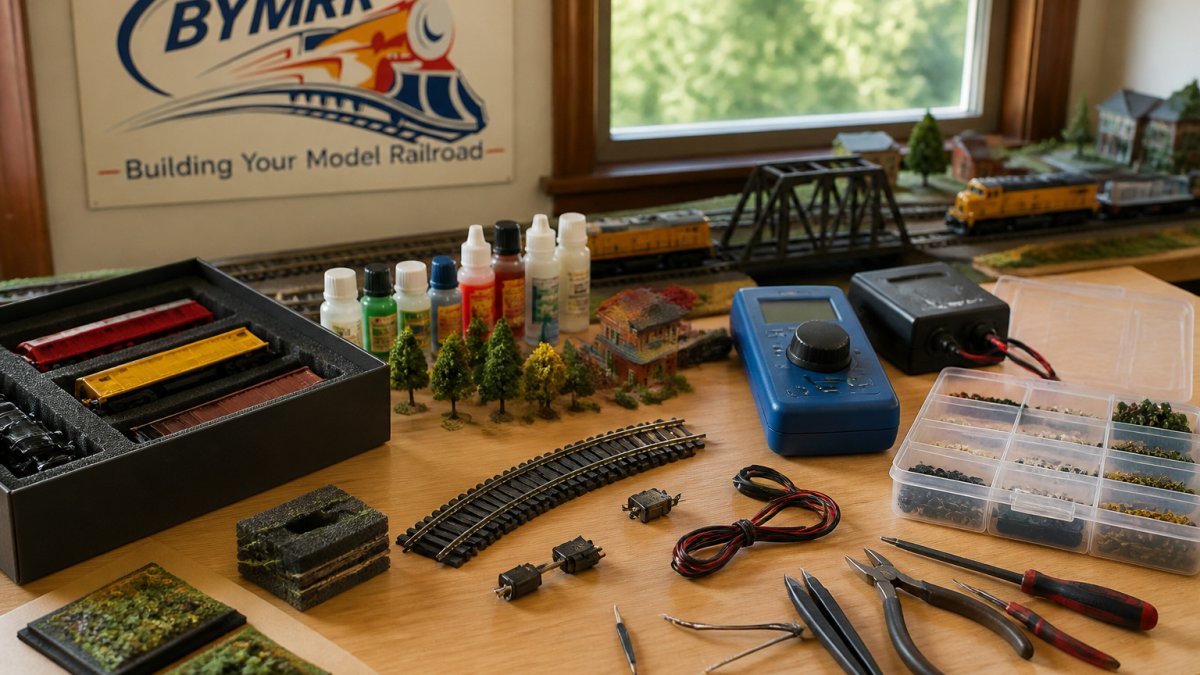
A model train accessory is any item that supports a layout without being the locomotive or rolling stock itself. Most beginners underestimate how many small parts it takes to run trains reliably. Plan for track, power, tools, scenery and cleaning supplies from the start.
Here is what we recommend buying first, in order of importance:
- Track: a simple oval with a few sidings
- Power: a DC or DCC controller matched to your locomotive
- Tools: cutters, a small screwdriver set, and a track gauge
- Maintenance: track cleaner and a soft cloth
Watch out: wiring a layout before you test each section can cost you hours of troubleshooting. Connect and test one loop at a time. Follow the step-by-step guide to wiring a layout before you buy power supplies and wiring parts.
Model Train Track for Beginners: Choosing the Right Starter Track
Track is the foundation of any layout, so it deserves the most thought. Most beginners choose between snap-together sectional track and flexible track that you cut and join yourself. Each has real trade-offs, and the right pick depends on how much time you want to spend building.
Snap-together track is the easiest starting point. You connect pre-made sections in minutes with no tools. That speed matters when you want to run trains quickly and see results. Pre-made sections also come with built-in roadbed and standard radii, which helps a first layout come together.
Flex track gives you freedom to create curves and layouts of any shape. It costs less per foot and allows custom track plans. However, it takes more skill, and a poor joint can cause derailments that frustrate new builders.
Pros and Cons of Snap-Together Track
- Pros: Fast setup, no tools required, reliable connections, good for quick layouts
- Cons: Limited layout shapes, higher cost per foot, fixed curve radii
Snap-together track suits beginners who want to run trains within an afternoon. We recommend it for first-time builders with a small space.
Pros and Cons of Flex Track
- Pros: Custom layout shapes, lower cost per foot, flexible design options
- Cons: Requires cutting and soldering skills, steeper learning curve, more derailment risk if joints are poor
Flex track works well for builders who enjoy hands-on work and want a layout they design themselves. Many experienced hobbyists still prefer it for the freedom it offers.
Model Railroad Tools for Beginners: What to Keep in Your Toolbox
You do not need a full workshop to start. A small, focused set of tools covers most early tasks. Model railroad tools for beginners should handle cutting, fastening, measuring and cleaning.
A practical starter kit includes: the complete guide to essential model train building tools covers each tool in more detail.
- A pair of flush-cutting track nippers for clean rail cuts
- A small screwdriver set for switches and controllers
- A track gauge to check rail spacing
- A hobby knife and cutting mat for scenery work
- Needle-nose pliers for fine wire work
Buy quality tools once rather than cheap tools twice. Poor cutters crush rail ends and create rough joints. Keep your toolbox organized so you can find what you need during a session. A small tray or tackle box works well.
The table below lists the starter tools the article recommends and what each one is for.
| Tool | Used for | Note |
|---|---|---|
| Flush-cutting track nippers | Clean rail cuts | Poor cutters crush rail ends |
| Small screwdriver set | Switches and controllers | Basic fastening work |
| Track gauge | Checking rail spacing | Catches spacing errors early |
| Hobby knife and cutting mat | Scenery work | Protects your work surface |
| Needle-nose pliers | Fine wire work | Useful for wiring details |
Model Train Scenery for Beginners: Adding Life to Your Layout
Scenery turns a bare track plan into a convincing miniature world. Model train scenery for beginners is less about artistic talent and more about layering simple materials in a logical order: ground cover, texture, then details.
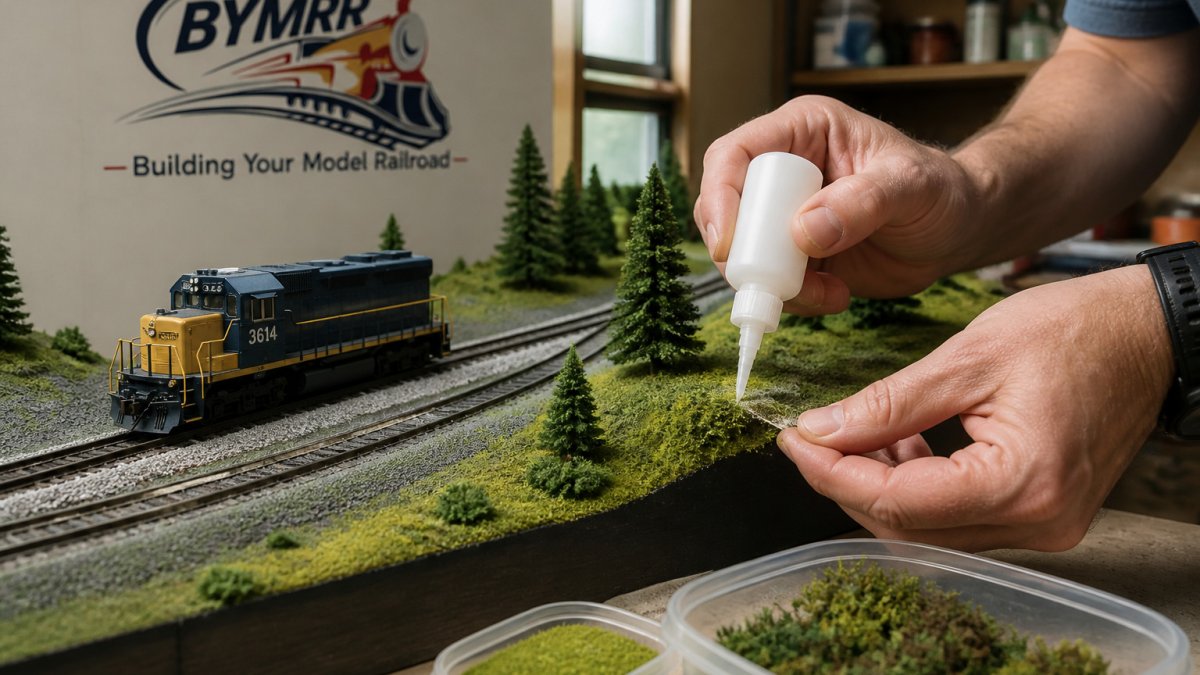
Start with a base of foam or plaster over the roadbed. Learn how to build scenery from scratch to see each layer built in order. Add ground foam or static grass for color. Then place trees, buildings and figures. Work in small sections so glue and paint can dry between steps.
A common mistake is adding too many details too early. Start with the main landscape and add small accents later. Scenery also helps hide the wiring and track edges, which makes the layout look finished.
Power Supplies, Controllers and Wiring Accessories
Power is the heartbeat of your layout. A DC controller suits a simple single-train setup. DCC systems give you independent control of multiple locomotives and offer more features, but they cost more. Choose based on how many trains you plan to run.
Wiring accessories keep everything connected reliably. You will need bus wire, feeder wires, terminal strips and a basic wire stripper. Solder joints at track connections, and label your wires as you go. Clear labels save hours of troubleshooting later.
Check that your power supply output matches your controller and locomotive specifications before connecting anything. Mismatched voltage can damage electronics.
Model Train Maintenance Kit: Keeping Derailments and Dirty Track at Bay
Derailments and poor electrical contact are the two most common frustrations for beginners. A small maintenance kit prevents both. Clean track regularly, check wheel gauge, and inspect joints for misalignment.
Your maintenance kit should include:
- Track cleaning fluid or a track-cleaning block
- Soft cloths and cotton swabs
- A wheel and track gauge
- A small brush for debris removal
Clean your track before each session, especially after running trains over dusty areas. Follow the step-by-step method for cleaning track effectively to get the best results. Learn how to prevent model train derailments before they happen. Dirty rails cause stuttering and poor electrical pickup. If derailments persist, check track alignment at joints and make sure curves are not too tight for your rolling stock.
Ordering Your Starter Accessories From BYMRR
BYMRR offers a comprehensive selection of locomotives, kits, accessories, and tools. BYMRR offers free shipping and a money guarantee, and provides support 24/7. Visit our Norfolk, Virginia store for in-person questions.
Pricing depends on the items you select, quantities and delivery options, so we recommend checking our website for current prices or requesting a quote. Start with the essentials in this guide, build your first loop, and add accessories as your layout grows.
Frequently Asked Questions
What accessories do you need to start a model train layout?
A beginner layout needs a starter set or track kit, a power supply matched to your train’s voltage, a controller to change speed and direction, track clips or a base board, and a basic toolkit with a screwdriver, track cleaner and small pliers. Scenery items such as ballast and trees can come later. Pricing depends on the scale, the size of your layout and whether you buy in bundles, so check BYMRR’s website for current prices or request a quote before ordering.
Do model trains need a special power supply?
Most model trains run on low-voltage DC or AC power supplied through a transformer or power pack. Check the voltage and current rating printed on your locomotive and set, then choose a power supply that matches it. Using a supply with too much output can damage motors, while too little can cause stalling on grades. A controller lets you adjust speed smoothly, and many beginners find a unit with built-in throttle and direction control easiest to start with.
What tools do you need for model railroading?
Start with a small screwdriver set, a track cleaning block or abrasive pad, flush cutters for trimming track and wire, a hobby knife, tweezers for placing small parts, and a multimeter for checking electrical connections. These basics cover most repairs and layout tasks. Add more specialized tools as your projects grow, such as a track gauge for checking alignment and a soldering iron for wiring feeders.
How do you add scenery to a model train layout?
Begin with a base layer of ground foam or dirt over a thin coat of white glue, then add ballast along the track so the ties stay visible and the rails remain clean. Place trees, buildings and figures last, after the ground is set and dry. Work in small sections so glue and ballast do not spill onto the track, and clean rails afterward to keep your locomotives running reliably.
